New Construction Is Booming — Here's How Agents Are Winning Those Deals in 2026
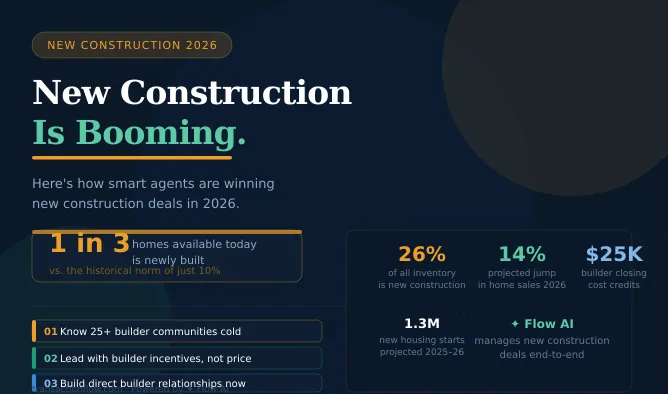
1 in 3 homes on the market today is brand new. Most agents are still treating new construction like a niche. The ones winning in 2026 are not.
Here is a number that should reframe how every real estate agent thinks about their business in 2026: newly built single-family homes now make up almost one-third of all available homes for sale — far above the historical norm of around 10%.
Read that again. One in three homes on the market today is new construction.
For the better part of two decades, new construction was a meaningful but secondary segment of most agents' business. Existing home inventory dominated the market, and new construction deals were a specialty — something some agents focused on, but not something every agent needed to master.
That math has permanently changed. Even in 2025's shifting market, new construction still represents over 26% of single-family inventory, and builders continue producing at strong levels, with new housing starts projected to stay in the mid–1.3 million range through 2025–2026. NAR forecasts a 14% jump in home sales in 2026, including further growth in new-home sales.
If new construction is 25–30% of your market but less than 25–30% of your business, you are leaving a significant and growing segment of the opportunity on the table — and handing it to the agents who have done the work to master it.
Here is exactly how the agents winning new construction deals in 2026 are doing it.
Understand Why New Construction Is Different — And Why Most Agents Get It Wrong
The first thing to understand about new construction deals is that they operate by a completely different set of rules than resale transactions — and most agents who dabble in this segment don't fully grasp those differences until a deal goes sideways.
In a resale transaction, you are negotiating with a motivated seller who has emotional attachment to their home, flexibility on price and terms, and a finite timeline driven by their personal circumstances. In a new construction transaction, you are negotiating with a builder — a corporation with standardized contracts, fixed pricing tiers, in-house sales teams, and a business model built around volume and margin protection.
Builders do not negotiate the way sellers negotiate. They rarely move on list price, because doing so undermines the value of every other unit in the community. What they do negotiate — when they have inventory to move — is incentives. Rate buy-downs. Closing cost credits. Upgrade packages. Extended rate locks. Builders in some markets are offering mortgage rate buy-downs, closing cost credits ranging from $10,000 to $25,000, and free upgrade packages to move near-peak inventory.
This is where agents who understand new construction create enormous value for their buyers — and where agents who don't understand it fail their clients by focusing on the wrong negotiating lever.
The second thing most agents get wrong: they treat builder sales representatives as adversaries. The builder's on-site sales rep is not your opponent. They are your partner in getting the deal done. Agents who build genuine relationships with builder sales teams get early access to pre-release pricing, heads-up on upcoming communities, and inside information on where the builder has flexibility on incentives. Agents who walk in cold and try to negotiate against the sales rep get none of that.
Strategy 1: Know Your Builder Communities Cold — All 25+ of Them
The agents who dominate new construction in their market have done something most agents haven't: they've done the work to actually know the builder communities in their area at a deep level.
Within five days of committing to new construction, you should know at least 25 communities well enough to speak about them confidently on camera or in conversation. That means visiting model homes, talking to on-site sales reps, understanding pricing tiers, available floor plans, included features, upgrade options, HOA structure, estimated completion timelines, and what makes each community different from the others.
This level of knowledge transforms a new construction conversation with a buyer. Instead of vaguely mentioning that "there are some new communities in the area," you can say: "Based on what you've told me about your priorities, I want to show you three communities — here's why each one might be the right fit, and here's what to watch for in each."
That level of specificity builds buyer confidence. It signals expertise. And it dramatically increases the likelihood that your buyer trusts your guidance enough to move forward rather than spending three months driving from community to community on their own.
Maintaining this knowledge requires a system. Builder pricing changes. Communities sell out. New phases open. Completion timelines shift. Agents who stay current on their community knowledge have a process for regularly checking in with builder reps, tracking what's available, and updating their buyer-facing communications accordingly.
TransactionFlow's Floor Plans and Photos feature and the Network feature make it easier to maintain organized, accessible records of your builder relationships and community knowledge — so that information is always available when you need it, not scattered across text messages and browser bookmarks.
Strategy 2: Lead With Incentives, Not Price
One of the most common mistakes agents make with new construction buyers is framing the conversation around list price negotiation — and then feeling stuck when the builder won't move on price.
Smart new construction agents have flipped this entirely. They lead with incentives.
Colorado real estate agents who represent buyers in these deals can use builder incentives as a real competitive advantage in 2026. The same is true in markets across the country. A $20,000 closing cost credit has the same financial impact as a $20,000 price reduction — but builders will almost always give you the former before they'll consider the latter, because it protects their comp structure for the rest of the community.
Rate buy-downs are particularly powerful in the current rate environment, where buyers are payment-sensitive. A 2-1 buy-down that reduces the buyer's rate by two points in year one and one point in year two can mean hundreds of dollars per month in savings during the adjustment period — which is often exactly what a hesitant buyer needs to feel comfortable moving forward.
When you understand the full menu of builder incentives available and can present them clearly and compellingly to your buyers, you become the agent who solves problems other agents can't. That is a referral-generating skill, not just a transaction skill.
Strategy 3: Build Direct Builder Relationships Before You Need Them
The agents who consistently win new construction deals aren't making cold calls to builder sales centers when a buyer asks about new homes. They already have relationships in place — with sales representatives, community managers, and in some cases directly with the builders themselves.
In growing markets and construction markets, smart agents align with builders, sales centers, and relocation pipelines. This alignment doesn't happen by accident. It requires proactive relationship-building during the periods when you don't have an immediate transaction at stake.
What does that look like practically? It means visiting model homes regularly — not just when you have a buyer, but to stay current and maintain visibility with the sales team. It means attending builder events and community previews. It means following up after transactions to let the sales rep know how the closing went. It means being the agent that builder sales reps recognize, trust, and think of when a buyer comes in unrepresented.
That last point matters more than most agents realize. When a buyer walks into a model home without an agent, the builder's sales team will typically give that buyer 24–48 hours to register an agent before the deal is considered unrepresented. The agents whose names come to mind when the sales rep is asked "do you know a good agent I could refer this buyer to?" are the ones who have invested in those relationships consistently.
TransactionFlow's Network feature is designed exactly for this — keeping your builder relationships organized, tracked, and active, with touchpoints that keep you visible without requiring you to manually remember when you last reached out to each contact.
Strategy 4: Master the New Construction Transaction Process
New construction deals have a different transaction arc than resale deals — and the agents who handle them smoothly are the ones who have internalized that difference.
The timeline is longer and more variable. A resale deal typically closes in 30–45 days. A new construction deal can take 6, 9, or 12+ months from contract to close, depending on where the home is in the build cycle. Builder-caused delays — material shortages, weather, labor scheduling — are common and often not compensable to the buyer. Managing client expectations through a months-long build process requires a communication system, not just good intentions.
The contract is different. Builder contracts are written by the builder's legal team, heavily favor the builder, and are substantially less negotiable than a standard residential purchase agreement. Agents who don't read builder contracts carefully — or who don't understand the standard provisions — can fail to flag terms that significantly impact their buyer's rights and flexibility.
The inspection is different. New construction buyers often assume that because a home is brand new, it doesn't need an inspection. This is a dangerous assumption. New construction homes have defects — sometimes significant ones — and the agents who advocate for their buyers insist on an independent inspection regardless of the builder's quality assurance process.
The closing timeline is different. Because the close date is tied to construction completion rather than a negotiated timeline, it can shift — sometimes repeatedly. Buyers need to have rate lock strategies and living situation flexibility to accommodate changes in the close date. Agents who surface these issues early and help buyers plan for them prevent the last-minute scrambles that damage client relationships.
TransactionFlow's Deals feature handles new construction as a distinct deal type, with automated task lists and deadline tracking built for the longer, more variable timeline of a new construction transaction. Flow AI monitors the deal and surfaces upcoming milestones — so nothing slips during the months between contract and close.
Strategy 5: Position Yourself as the New Construction Expert — Publicly
The final strategy is the one that creates compounding returns: becoming known as the new construction expert in your market, not just being one.
Buyers who are considering new construction are actively searching for information. They want to know which builders are reputable. They want to understand the difference between production builders and custom builders. They want to know which communities have the best schools, the best HOA management, the best resale history. They want to know how to navigate the builder contract and what to watch for.
The agents who create content that answers these questions — community tours, builder comparison videos, new construction buying guides, first-time new construction buyer tips — attract buyers who are already pre-disposed toward new construction before they've ever spoken with an agent. Those buyers are the easiest conversations because they already want what you specialize in.
Sustainable visibility beats short bursts of attention. Long-term growth comes from showing up consistently with a recognizable message and style. In new construction, that consistency compounds quickly because the audience is actively growing — more buyers are considering new construction now than at any point in the past two decades.
New Construction + TransactionFlow: Built for the Complexity
New construction deals are operationally more complex than resale deals. Longer timelines, more parties involved, more documentation, more check-ins with more people over more months. Without a system to manage that complexity, even experienced agents can struggle to keep every deal moving cleanly.
TransactionFlow's platform handles new construction as a first-class deal type — with workflows, task automation, deadline tracking, and party coordination built for the specific arc of a new construction transaction. The 630+ automated templates include new construction-specific communications for every stage of the deal, from contract through build updates to pre-closing coordination.
Flow AI monitors your new construction pipeline and surfaces what needs attention — the builder update that hasn't come in, the buyer check-in that's overdue, the rate lock expiration that's approaching — so you can focus on building the relationships and expertise that win the next deal while the system manages the current ones.
Founding members get access to all of this — every deal type, every feature, every template — at 25% off, locked for 24 months, when TransactionFlow launches this summer.
New construction is the biggest single opportunity in most agents' markets right now. The agents who win it consistently aren't doing it with harder work. They're doing it with better systems, better relationships, and better knowledge than their competition.
Join the founding waitlist and build your new construction business on the right infrastructure →
TransactionFlow is the all-in-one operating system for real estate agents — 19+ features, 630+ automated templates, 50-state compliance, powered by Flow AI. Built by agents. Launching Summer 2026.
