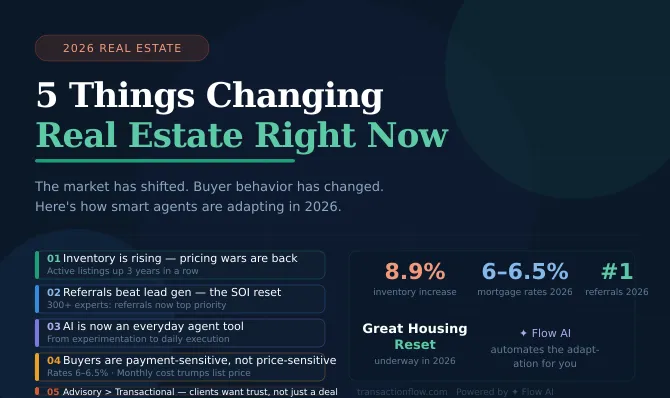
5 Things Changing Real Estate Right Now — And How Smart Agents Are Adapting in 2026
The market has shifted. Buyer behavior has changed. Here's how smart agents are adapting in 2026.
Every few years, the real estate market hits a reset point — a moment when the strategies that worked before stop working as well, new patterns emerge, and the agents who adapt fastest pull ahead of the ones still running last cycle's playbook.
2026 is one of those moments.
After two years of historically low inventory, rate-shocked buyers sitting on the sidelines, and a market defined more by scarcity than strategy, the landscape is shifting. According to Realtor.com's forecast, housing inventory could increase 8.9% in 2026 — though it would still sit about 12% below pre-COVID averages. Mortgage rates are stabilizing. Buyer behavior is evolving. And the tools and strategies that define a competitive agent in this environment look meaningfully different than they did even 18 months ago.
Here are the five most important shifts happening in real estate right now — and exactly how smart agents are responding to each one.
1. Inventory Is Rising — And Pricing Is Everything Again
For the past several years, low inventory gave sellers enormous leverage. Homes sold quickly, often above asking, often with limited contingencies, and the agent's job was largely to manage demand rather than create it.
The number of active listings has been rising for three years in a row, and some markets are now returning to pre-pandemic levels. That changes the dynamic significantly — for both buyers and sellers, and for the agents representing them.
In a rising inventory environment, sellers can no longer assume that any price will attract offers. Sellers who overprice their homes will sit on the market, while well-priced homes will move. The agents who thrive in this environment are the ones who can have honest, data-driven pricing conversations — not the ones who tell sellers what they want to hear to win the listing.
This means agents need hyper-local data at their fingertips. Days on market, price reduction rates, absorption rates, comparable sale timelines — the kind of granular, neighborhood-level insight that separates a pricing conversation backed by evidence from one backed by instinct. Local absorption rates, months of inventory, median days on market, and price reductions now provide faster signals than national headlines.
What smart agents are doing: Building market update systems that pull local data automatically and keep both buyers and sellers informed throughout the transaction — not just at the beginning. TransactionFlow's Analytics feature gives agents a real-time view of their pipeline and market performance, while the automated template library includes pre-built market update communications for every stage of the deal.
2. Referrals Have Overtaken Lead Generation — The SOI Reset
This is arguably the biggest strategic shift in real estate marketing in 2026, and it's being underreported.
Based on insights from over 300 seasoned experts, the goal to increase referrals has surpassed general lead acquisition as the top priority for real estate professionals entering 2026. This shift reflects what researchers are calling a "flight to safety" — agents moving away from expensive, unpredictable lead generation channels and doubling down on their Sphere of Influence (SOI), where the ROI is higher, the relationships are warmer, and the conversion rates are dramatically better.
The math behind this shift is compelling. A referral from a past client comes pre-loaded with trust. The referred buyer or seller already has a positive association with you before the first conversation. They're more likely to move forward, less likely to shop you against competitors, and more likely to refer others in turn. Compare that to a cold lead from a paid channel — which requires nurturing, skepticism management, and significant time investment before a commission is even possible — and the economics are clear.
Real estate is becoming less transactional and more advisory. Clients want an agent they can trust, not just someone who can help them close a deal. That trust is built over time through consistent, genuine communication — not through a single transaction.
The challenge for most agents is that staying genuinely top of mind with hundreds of past clients is nearly impossible to do manually. It requires a system — milestone touchpoints, home anniversary outreach, market updates, review requests — firing consistently and automatically without the agent having to remember who needs what communication when.
What smart agents are doing: Building automated post-close nurture sequences that keep past clients engaged long after the transaction ends. TransactionFlow's CRM connects directly to the transaction pipeline, so when a deal closes, the nurture sequence activates automatically. The Gift feature handles physical client appreciation automatically. And with 630+ pre-built templates, every touchpoint is already written — agents just need to activate the system.
3. AI Has Moved From Experimentation to Everyday Use
A year ago, AI tools in real estate were still largely in the "interesting but optional" category. Agents were experimenting with AI for writing listing descriptions, generating social content, or answering basic questions. Most were still doing the core work of their business — client communication, transaction coordination, follow-up management — manually.
In 2026, agents are using AI to support the work they already do well. From planning content and refining messaging to organizing follow-ups and understanding performance, AI helps reduce friction and create consistency.
The agents winning with AI right now aren't using it to replace themselves — they're using it to multiply themselves. AI handles the drafting, the preparation, the first-pass work that used to eat 30-45 minutes of manual effort per task. The agent handles the judgment, the relationship, and the final review. The result is that one agent can now do the communication and coordination work that previously required a transaction coordinator, a marketing assistant, and a personal assistant — without losing the personal touch that makes clients feel genuinely cared for.
The current housing landscape is demanding a critical operational reassessment from real estate professionals, with focus decisively shifting toward maximizing efficiency, controlling costs, and prioritizing high-ROI strategies. AI is the lever that makes all three of those things possible simultaneously.
The key distinction — and what separates useful AI from dangerous AI in real estate — is whether the agent stays in the loop. An AI that drafts, prepares, and suggests while the agent reviews and approves is a force multiplier. An AI that acts autonomously, sending communications without review, introduces risk that no commission is worth.
What smart agents are doing: Using AI tools that prepare rather than replace. TransactionFlow's Flow AI monitors active deals and drafts communications — status updates, party coordination emails, client check-ins — that are ready for agent review before anything goes out. The agent is always the final decision-maker. Flow AI just makes sure the first draft is already done.
4. Buyers Are Payment-Sensitive, Not Price-Sensitive
Here's a shift that has quietly changed the way real estate conversations work — and many agents are still catching up to it.
Mortgage rates are forecast to remain in the 6–6.5% range through 2026, and buyers have become more payment-sensitive, with monthly cost now trumping listing price. This means that a buyer who balks at a $450,000 list price might be perfectly comfortable with that same home if the conversation shifts to monthly payment, rate buydown options, or adjustable-rate structures that lower the near-term cost.
The agents who understand this shift are reframing their buyer conversations entirely. Instead of leading with price, they're leading with payment scenarios. Instead of presenting one financing option, they're partnering closely with lenders to present multiple cost structures for every property. Mortgage lenders and agents need to collaborate closely to provide pre-approvals, rate locks, and cost breakdowns.
This also changes how agents handle buyer objections. "The price is too high" is a much harder objection to overcome than "the monthly payment is too high" — because the monthly payment is a math problem, not a valuation disagreement. When agents reframe around payment, they open up creative financing conversations that can move buyers off the fence without requiring a price reduction from the seller.
Buyers enter the market later than in previous cycles. The share of first-time buyers has declined compared with historical norms. The buyers who are in the market right now are more financially sophisticated, more research-driven, and more likely to need education and context before they feel confident making a move.
What smart agents are doing: Updating their buyer communication templates to include payment scenarios, rate context, and financing education alongside traditional market data. TransactionFlow's 630+ automated templates include buyer-specific communication sequences that can be updated to reflect current rate conditions and payment-focused messaging — keeping buyers informed and engaged through the entire search and transaction process.
5. The Shift From Transactional to Advisory — Trust Is the New Differentiator
The fifth and most fundamental shift happening in real estate right now is harder to measure than inventory levels or mortgage rates — but it may be the most important one for the long-term health of an agent's business.
The future of real estate marketing is not about being louder or doing more. It is about being intentional, adaptable, and consistent. Agents who combine technology, video, trend awareness, and a strong personal brand will continue to earn attention and turn it into lasting trust.
The commoditization pressure on real estate agents — from discount brokerages, iBuyers, and AI-powered search tools — has been building for years. The agents who have weathered that pressure most successfully are the ones who have leaned into what technology cannot replicate: genuine expertise, trusted relationships, and the ability to guide clients through one of the most complex and emotionally charged decisions of their lives.
Real estate is becoming less transactional and more advisory. Clients want an agent they can trust, not just someone who can help them close a deal. That distinction is showing up in how clients choose agents, how they talk about agents after the transaction, and whether they come back — and send referrals — in the years that follow.
The advisory shift requires agents to invest in their expertise, their communication, and their visibility in ways that go beyond the transaction. Market knowledge that gets shared proactively. Educational content that helps buyers and sellers understand what's happening and why. Consistent presence that reminds past clients you're still their agent, not just someone they worked with once.
Sustainable visibility beats short bursts of attention. Long-term growth comes from showing up consistently with a recognizable message and style. Agents who publish regularly build trust faster and stay top of mind longer.
What smart agents are doing: Building content and communication systems that position them as the local expert — not just the local agent. TransactionFlow's Network, Media, and Academy features support exactly this kind of authority-building, while the platform's automated communication infrastructure ensures agents show up consistently for every client without the manual effort that makes consistency unsustainable at scale.
The Agents Who Win in 2026
The agents who thrive in 2026 won't be the ones waiting for perfect market conditions. They'll be the ones adapting to new trends, anticipating market shifts, and positioning themselves as the go-to experts.
That's a useful framing — but it's incomplete. Adapting to new trends requires more than awareness. It requires infrastructure. Systems that execute consistently. Tools that multiply your capacity without multiplying your workload. A platform that handles the operational complexity of the business so you can focus on the advisory work that clients actually value.
The five shifts above — rising inventory, referrals over lead gen, AI mainstreaming, payment-sensitive buyers, and the advisory pivot — all point in the same direction. The 2026 real estate market rewards agents who have built real systems, real relationships, and real expertise. It does not reward agents who are still duct-taping their business together with 10 disconnected tools and hoping nothing slips.
TransactionFlow was built for exactly this moment. One operating system that handles transactions, nurtures clients, and grows your business — powered by Flow AI, built by agents who have closed over 200 homes and $85M in career sales, and available to founding members at 25% off before the Summer 2026 launch.
If 2026 is the year you finally build the infrastructure your business deserves, this is where you start.
Join the founding waitlist — 25% off locked for 24 months →
TransactionFlow is the all-in-one operating system for real estate agents — 19+ features, 630+ automated templates, 50-state compliance, powered by Flow AI. Built by agents. Launching Summer 2026.
